



 EN
EN  VI
VI  CN
CN Blog
What impact will have on China’s polypropylene market? While escalating geopolitical risks in the Middle East

Introduction: Escalating geopolitical tensions in the Middle East, disruptions to Red Sea shipping, and potential production disruptions in major oil-producing countries have triggered significant volatility in global energy and chemical markets. As one of the world’s most important producers and exporters of polypropylene, the instability in the Middle East may impact the landscape of China’s polypropylene market through both cost transmission and supply chain disruptions.
I. Domestic USD market sees significant price increase; price increase and market closure occur simultaneously.
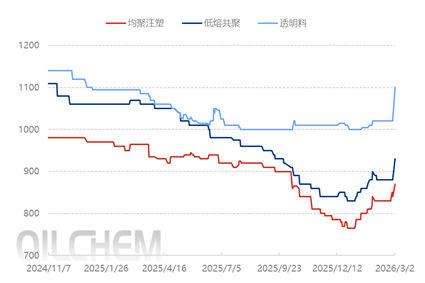
Figure 1. Price Trend of Different Polypropylene Grades (USD/ton)
Data source: Longzhong Information
Driven by concerns over tightening supply due to the escalation of geopolitical conflicts in the Middle East, as well as a sharp increase in logistics costs caused by disruptions to Red Sea shipping routes, China’s imported polypropylene USD market showed a broad and significant upward trend on March 2. As illustrated, CFR China USD quotations for various product categories—including homo injection, low melt copolymer, and transparent grades—rose sharply in a short period.
The market expects a reduction in arrivals of Middle Eastern import cargoes, with polypropylene shipments from the region likely to decline significantly over the next 1–2 months. Some vessels originally scheduled to arrive in March and April may be delayed or even canceled due to buyers defaulting on cargoes or being redirected to higher-priced regions.
However, given China’s rapidly increasing self-sufficiency in polypropylene, the import market has been under long-term pressure. At present, importer sentiment is clearly diverging: some players have quickly withdrawn offers and are holding back cargo in anticipation of further price increases, while others—after enduring prolonged pressure over the past year—are taking advantage of the current bullish news to actively sell and reduce inventories, albeit at sharply higher prices.
II. Geopolitical concerns trigger cost increases, leading to a significant rise in the domestic spot market.
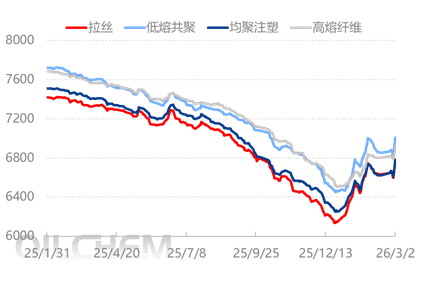
Figure 2. Price trend of polypropylene in the domestic market (unit: yuan/ton)
Data source: Longzhong Information
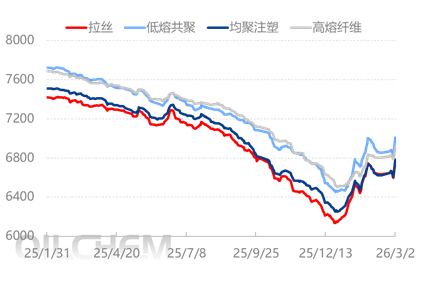
China’s polypropylene raffia market price increased by RMB 168/ton from RMB 6,595/ton last week, representing a gain of 2.55%. Although there has been no significant reversal in domestic supply and demand, the sudden escalation of the Middle East situation has driven up crude oil prices, thereby substantially strengthening cost support for polypropylene producers. Given that all five major PP production processes are currently operating at a loss, producers have raised prices accordingly.
According to Longzhong, domestic producers have generally increased prices by more than RMB 200/ton, leading to a rapid follow-up rise in market prices. As the future direction of the situation remains uncertain, some traders are withholding offers and holding back cargo, while overall trading activity has become more active.
III. Diversification of Import Structure: Non-Middle East Share May Increase
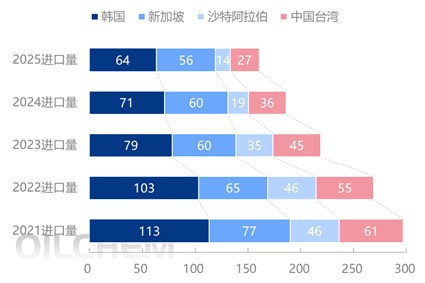
Figure 3. China’s Polypropylene Imports by Source Region (2021–2025, 10,000 tons)
Data source: Longzhong Information
Table 1. Analysis of China’s Polypropylene Imports by Country and Region (2021–2025, 10,000 tons)
| Countries and Regions | 2021 | 2022 | 2023 | 2024 | 2025 |
| South Korea | 113.32 | 103.18 | 78.51 | 71.04 | 63.53 |
| Singapore | 76.64 | 65.41 | 60.37 | 60.07 | 55.81 |
| Saudi Arabia | 46.48 | 45.82 | 34.87 | 19.37 | 14.09 |
| Taiwan, China | 60.5 | 54.53 | 45.3 | 35.73 | 27.43 |
| Others | 182.87 | 182.15 | 192.63 | 180.92 | 175.95 |
| Total | 479.81 | 451.09 | 411.68 | 367.13 | 336.81 |
China’s polypropylene import structure is diversified. In addition to Middle Eastern supply, nearby sources such as South Korea and Japan are also major exporters to China. The ongoing escalation of geopolitical tensions in the Middle East may accelerate a notable increase in the market share of non-Middle Eastern supply.
Faced with supply uncertainties in the Middle East and high freight premiums, Chinese importers are actively adjusting their procurement strategies to mitigate the risk of supply disruptions and control costs. With advantages such as shorter transit times and lower logistics risks, cargoes from South Korea and Southeast Asia are becoming increasingly competitive and are expected to serve as key alternatives to fill the supply gap.
This strategic shift in sourcing not only reduces China’s reliance on a single Middle Eastern supply region and enhances supply chain resilience, but also contributes to a restructuring of global polypropylene trade flows.
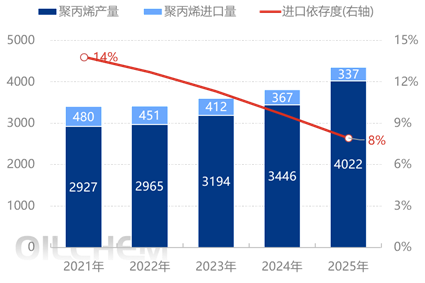
Figure 4. Trend of China’s Annual Polypropylene Imports and Import Dependency (2021–2025, 10,000 tons)
Data source: Longzhong Information
In addition, with China’s supply expanding rapidly and self-sufficiency improving significantly, polypropylene imports have been declining year by year. As China’s capacity growth has outpaced the combined growth of the rest of the world, the increase in domestic production has far exceeded the growth in globally available export volumes. As a result, from 2021 to 2025, China’s dependence on polypropylene imports has continuously decreased.
Given that most of the new global polypropylene capacity is concentrated in China, and domestic producers have actively benchmarked and developed grades that previously relied on imports, import substitution has become increasingly evident in certain segments. By 2025, imports are expected to decline to around 3.37 million tons, marking a significant drop.
Therefore, it is unlikely that geopolitical conflicts overseas will lead to actual supply shortages in China’s polypropylene market. Instead, the impact is more likely to be reflected in costs and shipping dynamics.
In summary, the escalation of geopolitical risks in the Middle East has impacted China’s polypropylene market more through cost-push factors than direct supply disruptions. In the short term, driven by logistics constraints and supply concerns, import USD prices have surged significantly. Some traders have taken the opportunity to withdraw offers and hold back cargo, while others have accelerated inventory liquidation, pushing the domestic spot market higher.
However, from a medium- to long-term perspective, the rapid expansion of China’s polypropylene production capacity and the continuous improvement in self-sufficiency have built strong market resilience, effectively mitigating the risk of actual shortages caused by overseas supply disruptions. Meanwhile, in response to uncertainties surrounding Middle Eastern supply, China’s import structure is accelerating toward diversification. Nearby sources such as South Korea, with their logistical advantages, are filling the gap and further strengthening supply chain resilience.
In response to the Middle East situation, China’s propylene market should focus on three key variables:
First, the feedstock cost side: closely track fluctuations in crude oil and propane prices, and remain alert to rising energy premiums that could push up the cost floor of oil-based and PDH production processes.
Second, the logistics and freight side: monitor in real time the surge in freight rates and extended shipping times caused by disruptions in Red Sea routes, and assess their impact on CFR import costs and cargo arrival schedules.
Third, the supply substitution side: pay attention to the replenishment efficiency of non-Middle Eastern sources such as South Korea, in order to evaluate whether the market can effectively mitigate structural supply shortages.