



 EN
EN  VI
VI  CN
CN Blog
Tight Supply–Demand Balance Drives the Start of a Price Upcycle in China’s Domestic PC Market in 2026

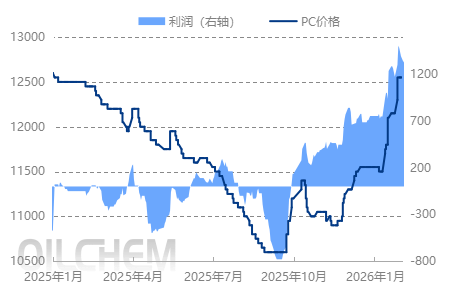
Introduction: Since the beginning of 2026, the domestic PC market has shown a significant upward price trend, breaking the previous nearly four-year-long pattern of fluctuating and bottoming out. According to data monitored by Longzhong Information, as of the end of January, the mainstream negotiated price range for domestically produced PC injection molding grade in East China was 11,400-12,850 yuan/ton, an increase of 500-1,000 yuan/ton compared to the end of December. The price increase far exceeded market expectations, while the industry’s gross profit also rose to 1,095 yuan/ton in the same month, a month-on-month increase of 48.58%. The core driving force behind this price increase stems from the formation of a tight supply-demand balance in the industry, coupled with the dual support of cost-side support and demand recovery. The domestic PC market is entering a new round of price increases.
Figure 1. Price and Profit Trends in the Domestic PC Market, 2025-2026 (RMB/ton)
Source: Longzhong Information
As of the end of January 2026, the mainstream negotiated price range for domestically produced PC injection molding grade in East China was 11,400-12,850 yuan/ton, an increase of 500-1,000 yuan/ton compared to the end of December, representing a rise of 4.55%-8.44%. Among them, the overall increase in domestically produced genuine PC was larger, essentially recovering to the highest level since 2025. The industry’s gross profit for the month reached 1,095 yuan/ton, the highest level since the second quarter of 2023. Entering early February, the domestic PC market continued its strong upward trend, with domestic PC factories mostly raising ex-factory prices by 200-300 yuan/ton. Although spot market transactions gradually weakened, the overall negotiation focus showed no signs of easing, with some factories continuing to tentatively push prices higher.
- The supply and demand pattern is being reshaped, and the contraction of the supply side lays the foundation for a tight balance.
Figure 2. Statistics on changes in domestic PC supply from 2021 to 2025 (10,000 tons, 10,000 tons/year)

Source: Longzhong Information
From a supply perspective, the domestic PC industry will enter a capacity expansion “vacuum period” in 2026, becoming a core prerequisite for improving the supply-demand balance. After the concentrated expansion wave from 2018 to 2025, domestic PC capacity has jumped from 1.26 million tons to nearly 4 million tons. The domestic PC industry has moved from a “capacity shortage” stage to a “structural balance” stage. In 2025, the capacity utilization rate of the domestic PC industry reached 86%, which is the upper limit of the industry’s supply-demand balance critical point. There are no clear plans for new capacity to be put into operation throughout 2026, and the year-on-year growth rate of supply has slowed significantly. At the same time, the industry’s routine plant shutdowns for maintenance and reduced load operations will lead to a period of supply contraction, which will further exacerbate the tight market situation. In the first half of the year, market supply remained basically rigid, while domestic PC plants such as Hainan Huasheng, Zhangzhou Chimei, Covestro, and Shanghai Mitsubishi all had planned maintenance or production reduction operations due to factors such as equipment maintenance and process upgrades. The supply loss may be around 100,000 tons, further tightening the market supply.
2. Diversified growth in demand creates a rigid pull.
The multi-dimensional expansion of demand has become a key driver of price increases. As a core application area for PCs, the electronics and electrical industry, while facing pressure from extended product replacement cycles, is experiencing steady growth in emerging demands such as 5G communication equipment and precision components for smart terminals, continuously releasing demand for high-fluidity, high-insulation PCs. The explosive growth of the automotive industry, especially in the new energy vehicle sector, has become the core engine of demand growth. With the deepening trends of automotive lightweighting and electrification, PCs, with their excellent heat resistance, flame retardancy, and mechanical properties, are increasingly being used in components such as headlight covers, battery housings, and charging pile housings. The amount used per vehicle has increased from approximately 9.8 kg in 2020 to 12.5 kg in 2024. It is estimated that the production of new energy vehicles will exceed 12 million units in 2026, driving additional demand of over 180,000 tons. In addition, the continued expansion of demand in areas such as photovoltaic backsheets, medical protective equipment, and building energy conservation, coupled with the continued growth in exports to overseas markets such as Southeast Asia, constitutes multiple supports for PC demand.
3. Cost-side resonance strengthens price increase transmission.
Figure 3. Price comparison trend of upstream and downstream industries in the phenol-acetone industry chain (10,000 tons/year)

Source: Longzhong Information
The continued strength in upstream raw material prices provided rigid cost support for PC price increases in 2026. Bisphenol A (BPA), a core raw material for PC, is affected by fluctuations in upstream raw materials such as benzene and phenol. In January 2026, the spot price of benzene in East China climbed from 5,350 yuan/ton at the beginning of the month to 6,200 yuan/ton, a cumulative increase of 15.89%, while the price of phenol rose from 5,805 yuan/ton to 6,375 yuan/ton. Although the price increase of BPA, a direct raw material for PC, was relatively smaller, it still rose from 7,500 yuan/ton to 7,950 yuan/ton. The price increase resonance effect from upstream raw materials to downstream products was significant. For leading PC companies with integrated industrial chain layouts, their internal self-supply capabilities for key raw materials such as phenol and acetone effectively locked in cost margins, but the industry as a whole was still directly affected by raw material price fluctuations. This resonance of costs across the industrial chain further strengthened the rationality and sustainability of the PC price increase logic.
Looking ahead to 2026, the tight supply-demand balance in the domestic PC market will continue. The pattern of a temporary slowdown in supply growth and diversified demand growth is unlikely to fundamentally change. Costs will remain under upward pressure due to fluctuations in international crude oil prices. Overall, domestic PC prices are expected to enter a steady upward trend, with the average price for the year potentially increasing by more than 10% compared to 2025. For manufacturers, it is crucial to seize the profit opportunities presented by the price increase cycle, while accelerating the R&D and technological upgrades of high-end products to alleviate structural supply-demand imbalances. Downstream companies should rationally plan their procurement cycles and manage price volatility risks through long-term agreements and inventory optimization. Against the backdrop of accelerated domestic substitution and intensified global market competition, this price increase driven by a tight supply-demand balance may become a significant opportunity for the domestic PC industry to transform from scale expansion to quality and efficiency.